Prospects
A nature restoration opportunity for your land, funded through natural capital.
Hartmoor Farm
An assessment of your land, the ecological future that could be restored, and how natural capital can unlock it.
June 2026
An assessment of your land, the ecological future that could be restored, and how natural capital can unlock it.
At Restore, we start with what the land is missing, the natural processes that once drove its resilience, its dynamism, its capacity to support life. We assess what those processes were, what it would take to reinstate them, and what returns when you do. This report sets out what this looks like for your land, ecologically and financially.
Restore is a nature restoration company, we work with landowners across the UK to design, fund and deliver ecological recovery, across a range of habitats. Our team have broad expertise, with ecologists designing and delivering the restoration, commercial experts unlocking the finances, and communicators telling its story.
The intention of this tool is twofold. It provides an initial assessment of your land, through which our ecologists and land management specialists set out a grounded and feasible route to restoring its natural processes. It also translates that restoration into natural capital opportunities, demonstrating how nature recovery can generate a meaningful and lasting return for the landholding. This is grounded in our half-day visit, our discussions with you and the high-quality background and environmental data collated by our specialists.
At this stage, prospects is not intended to be a comprehensive ecological survey or recovery plan, these will come later. The figures are indicative and should not be interpreted as financial advice. It is intended as an affordable first step, and it carries no obligation or commitment to Restore. It is simply here to highlight the opportunities, help you plan your future, and make the case for economically viable nature recovery.
 Chapter One
Our starting point must always be the land itself: the history, the constraints, what is already there and how this is managed. With a firm grounding, we can identify what is missing and how to restore it.
Picture a farm in a river valley 300 years ago. A woodland of birch and oak covers the adjacent hillside. As the wood grew, it pulled carbon from the air and locked it into timber and soil, over decades. The canopy intercepts the rainfall, and the roots hold the soil firm, so that below, the brook runs clear and the valley is spared the worst of the winter floods. Fungi threaded through those roots move nutrients between trees and soil. The leaf litter feeds the insects, the insects feed the birds, and those birds range out across the fields and eat the pests that would otherwise strip the crops. Bees from the woodland edge move through the fields each spring, and the fruit follows.
What looks like a woodland is a web of dependencies running from the canopy to the soil, each layer holding up the one above. None of it appears in the farmer’s accounts. The system simply runs in the background, year after year, free and invisible.
Then someone offers to buy the wood and clear it for pasture, which on paper makes sense. What the numbers don't show is everything the wood was quietly doing: the soil it held, the water it cleaned, the floods it slowed, the pollinators it housed. Real value, but with no price on it. So, the accounts treat it as nothing, and a sensible farmer, reading sensible accounts, cuts the woodland down.
The brook runs brown after rain. The crops need more inputs to hold their yield. The songbirds stop singing. The carbon stored over centuries is released in a season.
The prospects assessment is about reading the land as it is today and uncovering those processes that have been lost. The initial site visit, paired with satellite data and existing environmental records, allows our ecologists to work out what natural processes this landscape once hosted, and which ones it needs to support the wider area, so we can show you what a nature-first transformation would look like.
At Restore, we begin with the ecology of a place, because that is the only way to see the systems that were lost, and understand what it would take to bring them back.
 Chapter Two
For most of the last century, nature on a farm was an unacknowledged cost, paid for in every flood and failed crop. As natural capital markets take shape, this is changing.
These markets direct private finance towards restoration, putting a value on the things a healthy landscape already does, holding water, sheltering wildlife, storing carbon. The money comes from organisations investing in healthier landscapes, whether to meet environmental commitments, protect the natural systems they rely on, or contribute to a future where nature thrives.
These routes come in different formats, some pay for carbon, others for biodiversity. Below, we explain the ones that might apply at Hartmoor. Natural capital can work alongside public schemes, and as a project develops this is something we consider case by case.
In England, most new development must leave nature measurably better off, by a minimum of ten per cent. A developer who cannot manage that on their own site pays for habitat to be created elsewhere, and the further that land is from the development, the more they must restore. That habitat is then looked after, usually for 30 years. If your land is well placed, it could be here. It tends to pay relatively early, once the habitat is delivered.
Commitment: 30 years. Creating and maintaining the habitat. Payments depend on local development and unit demand, so income arrives unevenly as units sell.
New woodland locks up carbon as it grows. Re-wetting peatland keeps the carbon already stored in the peat from escaping. That carbon is measured and independently verified, and sold as units that fund the recovery itself. It is long, patient income: it builds as the trees establish or the bog recovers, and it is checked along the way.
Commitment: 30 to 100 years. Carbon sequestered in the trees, or emissions abated in the peat.
A UK carbon standard centred on restoring native habitat by letting natural processes do the work. As those habitats recover, they draw down and store carbon, and the gain is measured and independently verified. It only sells to companies with a credible, science-based plan to cut their own emissions first. It rewards lasting carbon storage and measurable nature gain together, over a long commitment, which suits ground like yours.
Commitment: 50 years. Habitat creation and the carbon it stores.
Our own measure of land managed for nature, in step with the UK’s commitment to protect thirty per cent of land by 2030. One unit funds a year’s work renaturing thirty square metres. They are not tradeable and cannot be resold; companies buy them to back real nature recovery and count it towards their nature disclosures.
Commitment: ongoing, no fixed term. Not a lock-in but a lasting intention to keep the land in restoration. The more that commitment is secured, the further your land climbs toward fully counting toward the national target.
You cannot sell the same thing twice. Trees planted to earn a carbon credit cannot also be counted towards BNG, the same nature paid for once. Our natural capital and ecology teams keep the two separate.
It has to be real and additional. Buyers only pay for recovery that would not have happened without intervention.
It has to last. Recovery is committed and maintained for years, and repeatedly verified.
 Chapter Three
This chapter is only about your land. As well as the half day we spent walking the farm with you and recording drone footage, our ecology team has analysed the available records and satellite data. Here is what we found, field by field.
Hartmoor is lowland country, chalk on the higher ground and heavier clay down by the brook. Arable and sheep have been giving back a little less each year for the past decade, and you have come to us ready to ask what else this ground could do. We have grouped the recovery into five areas and marked the area that stays in hand. Tap a marker on the map, or a label beneath it, to read each one.
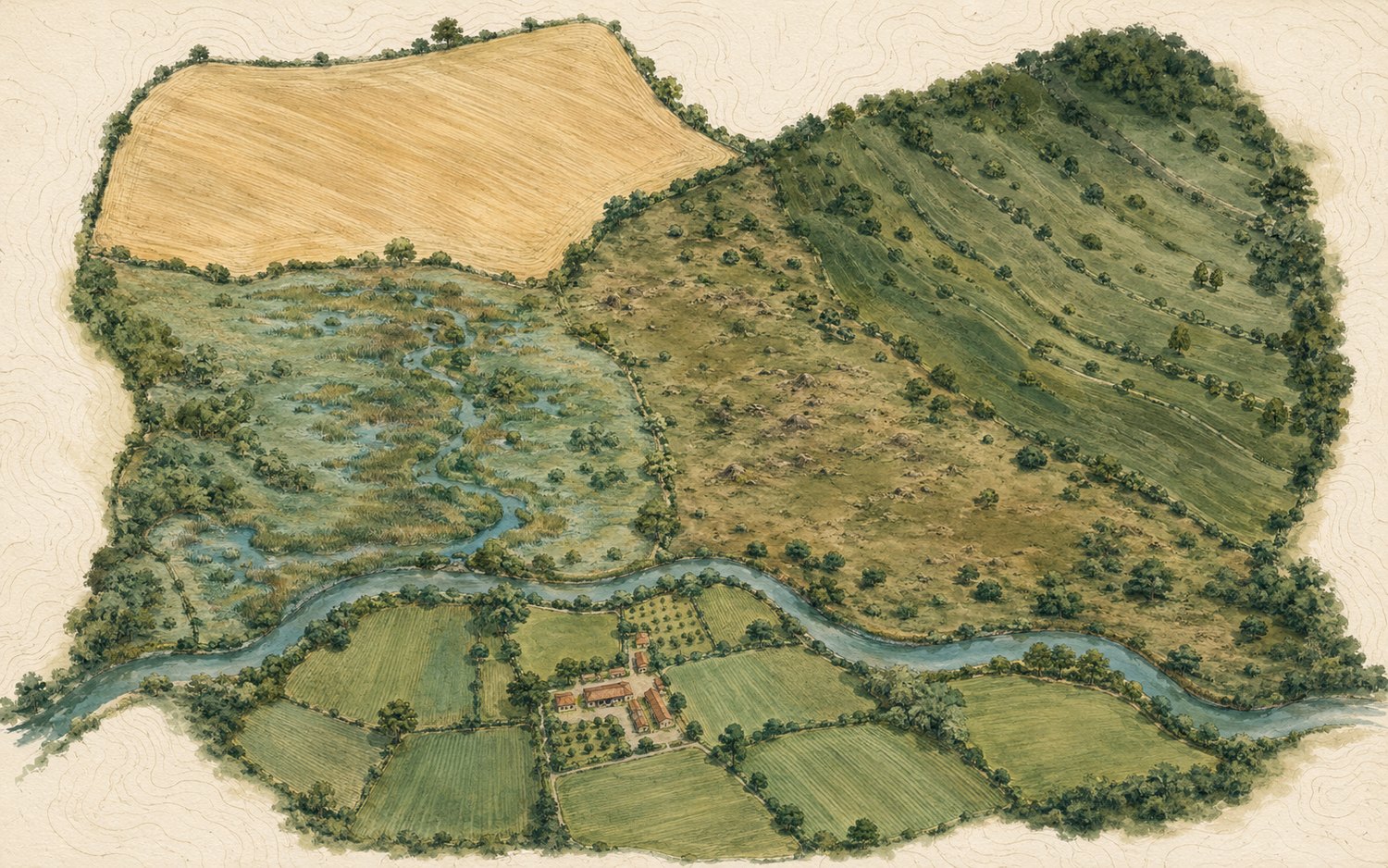
The painted estate map of Hartmoor. The brook runs west to east along the valley floor; the farmstead and the fields kept in production sit along it.
 Chapter Four
True ecological recovery cannot be built field by field.
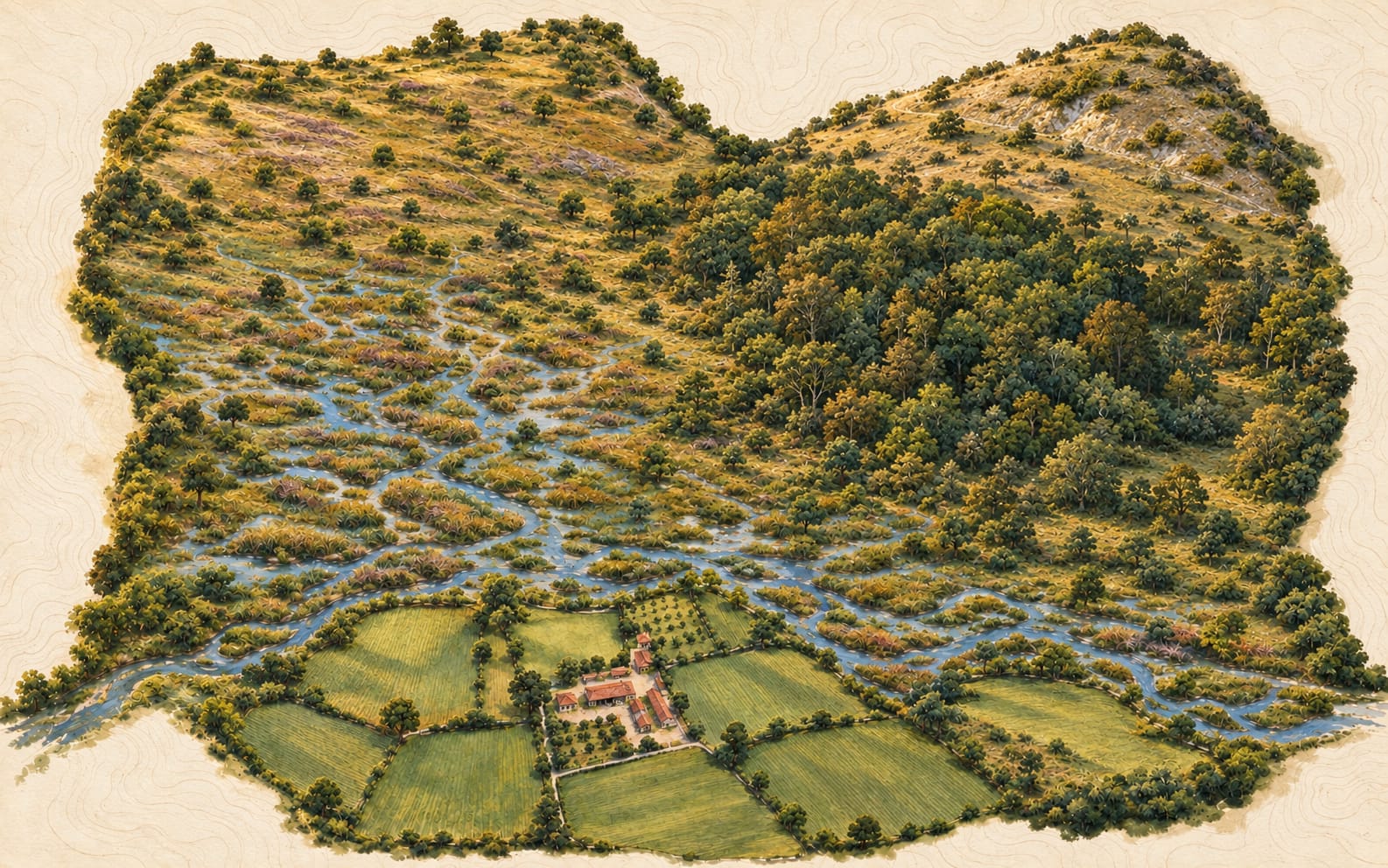
What we are designing is a landscape with restored ecological processes. A connected, dynamic system across the whole site, where wet ground is allowed to be wet, dry ground carries the grazing, scrub advances and is pushed back, and the spaces between habitats are as important as the habitats themselves. Connectivity allows species to move. Complexity provides them somewhere to be in every season, at every stage of their lives. Scale makes the whole thing feasible, ecologically, practically, and in terms of the monitoring evidence we need to demonstrate that recovery is real. This is what long-term resilience looks like: over time, a system rebuilt around natural processes becomes low-input and largely self-sustaining, riding out flood, drought and disease far better than a habitat held in place by constant management. Drag the slider across each photograph to reveal the transition.
The zones you will read about are not separate ambitions. They are component parts of a single landscape design, each one positioned relative to the others, each one intended to interact. Some habitats complement each other. Some are designed to succeed and then give way. The scrub that establishes on one slope this decade may be the open grassland of the next, and that dynamism is not a failure of management, it is the point. Species do not return to compartments. They return to landscapes.
For each zone we show the transition we would make and the ecological reasoning behind it. But read them as parts of a whole, not as individual decisions. It is only at this scale, designed as a system, that the recovery we are confident in becomes possible. The final map is our vision for a restored, connected and complex Hartmoor.
The transformations depicted in this chapter represent our best read from the data available on your area and its ecology. In practice nature is beautifully unpredictable, and the reality will likely stray from initial visioning exercises. The images used are AI generated.
 Chapter Five
Natural capital returns are shaped by the market price of each scheme, its costs, and its sales dynamics. All figures are net, after each scheme's own costs. Hover a graph to see that year's net and the running total.
 Chapter Six
There is no single right answer here, and no pressure from us. Your prospects is a first overview.
Read it, walk the fields with it, talk it over with the people around you, and see what surfaces.
Decide which futures suit you.
Work out how it gets paid for: funded yourself, or by an outside funder who carries the upfront cost for a share of the return. If you work with us, we walk you through both options.
The real work starts with a proper baseline, then a delivery plan, then the recovery itself, with monitoring as the land changes.